
A Sideways Summer That Tested Traditional Portfolios
September 30, 2026
In my opinion, the key to dealing with the future lies in knowing where you are, even if you can't know precisely where you're going.
—Howard Marks
Most forecasts assume the market is going somewhere. Every year starts with a list of them. Where rates will end up. What oil will do. How far stocks can run. Up or down, each one picks a direction.
This summer, the market mostly went nowhere. Stocks stalled after a strong start. Bonds fell at the same time. The part of the portfolio meant to provide stability didn’t.
Navigating that on forecasts would have meant calling three things at once:
- The 10-year Treasury yield breaking above 5%
- Oil rallying hard on top of it.
- Stocks stalling without ever breaking down.
We would rather respond to what markets are doing than depend on calling all three.
This month’s Note looks at a summer that tested traditional portfolios, why the ability to adapt matters more than the ability to predict, and what a systematic investing process does when markets rise, fall, or go nowhere.
But first, here’s a summary of the global asset classes utilized in our portfolios and their exposures for October.
Asset Allocation Update
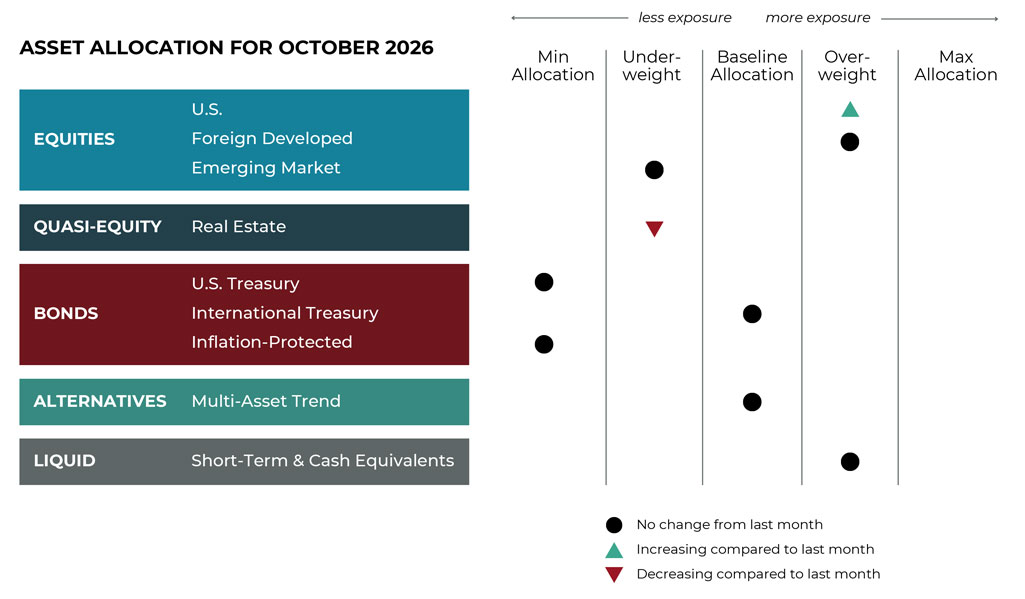
Source: Blueprint Investment Partners
Adjustments can vary across strategies depending on each strategy's objectives. What's illustrated above most closely reflects allocation adjustments for the Growth Strategy. Diversification does not guarantee investment returns and does not eliminate the risk of loss. Diversification among investment options and asset classes may help to reduce overall volatility.
U.S. Equities
Exposure will increase and remain overweight due to a combination of uptrends and taking on exposure from weakening real estate securities.
International Equities
Exposure will not change and the net allocation will remain at baseline, though foreign developed markets continue to be stronger (and thus overweight) while emerging markets are weaker (and thus underweight). Trends across all timeframes for both sectors remain positive.
Real Estate
Exposure will decrease and fall to underweight due to the emergence of an intermediate-term downtrend. The long-term timeframe remains positive for now.
U.S. & International Treasuries
Treasuries will remain underweight as they continue in downtrends and approach multi-year lows. To the extent exposure is positive, it is only due to the recently introduced adaptive fixed income ETF, which allows our strategies to seek to benefit from short allocations to bonds as prices fall.
Inflation-Protected Bonds
Exposure will remain at its minimum with downtrends across both timeframes.
Alternatives
Short-Term Fixed Income
Exposure will not change and remain overweight, as this asset class continues to hold allocations from weaker fixed-income instruments.
Asset-Level Overview
Equities & Real Estate
New all-time highs in August were quickly followed by more sideways movement in the S&P 500. While the index remains above the pre-August high, no additional ground has been gained thus far in September. With that said, trends remain firmly positive and as a result our portfolios are fully invested in U.S. stocks. Moreover, exposure from weakening real estate securities (see below for more) will be added to the U.S. equity allocation.
Like U.S. equities, international equities continue to hold uptrends. Those uptrends, however, are slightly more tenuous at the moment. Among the major asset classes Warren Wealth Management utilizes, foreign developed equities remain the top performer year-to-date. Emerging markets are also having a solid year of returns thus far, trailing only their developed counterparts and U.S. stocks. The bottom line is that international equities remain fully invested with a tilt toward developed markets.
Outside of fixed income instruments, the crunch from higher interest rates has been felt in real estate securities. This asset class was the poorest performer in September. The intermediate-term is negative, with the long-term trend remaining positive for now. Our portfolios will see a reduction in exposure, which will be handed to stronger U.S. equities.
Fixed Income & Alternatives
Fixed income instruments went from bad to worse in September, making new 2026 lows and challenging multi-year lows. Unsurprisingly, trends are negative and our exposure remains at its minimum. Additionally, the introduction of new trend-based ETFs designed to benefit from falling prices via short positions has allowed our strategies to be largely unaffected by declining bond prices.
Within the alternatives allocation, positioning is largely unchanged. Fixed income continues to be the largest net exposure (short prices, long rates). Commodities remain net long with a slight decrease in exposure. Equities also remain net long, but exposure came down more meaningfully heading into October, as several new short positions were added. Currencies remain tilted toward a net long position in international currencies (net short the U.S. Dollar).
3 Potential Catalysts For Trend Changes
Economic Report Card: The economy is a mixed bag right now. President Donald Trump’s tax cuts, fewer regulations, and major investments in AI are driving strong economic growth. But tariffs and the growth of data centers have pushed inflation higher. The war with Iran has led to an energy shock, raising prices for gasoline, diesel, and heating oil. Unemployment is low at 4.1%. The Federal Reserve says household net worth reached $186 trillion in the second quarter, up $26 trillion since late 2024, thanks in part to a strong stock market. August retail sales were better than expected, showing that people are still spending. The yield on 10-year Treasuries, which affects long-term interest rates, briefly went above 5% for the first time since 2023. Futures markets suggest there is about a 50% chance the central bank will raise rates again in October, just before Election Day. Most Fed officials expect one more rate hike by year-end. In August, consumer prices were 3.4% higher than a year ago, continuing a five-year trend of rising prices. For five months, wage increases have not kept up with inflation, and with the recent jump in gas prices, they likely won’t this month either. Since January 2021, when President Joe Biden took office, consumer prices have risen by 27%.
Housing Issues: The average 30-year mortgage rate reached 7.03% recently, the first time it has gone above 7% since early last year. While this number does not have special economic meaning, it affects how buyers feel. Economists say that when mortgage rates are above 7%, more people decide not to buy, which keeps the housing market slow. Before 2022, rates had not reached 7% since 2001. In February, rates dropped below 6% for the first time since 2022, which got buyers interested again and raised hopes for a strong spring selling season. But when the Iran conflict began, oil price and trade disruptions pushed rates back up, and the spring market slowed down. As rates kept rising, home sales fell. Economists say the housing market has made progress this year, as more people with new jobs or growing families moved despite higher costs. Still, the industry is waiting for the recovery it has been hoping for.
Apartment Woes: Rising interest rates are hitting America’s apartment landlords hard. These owners face over $1.8 trillion in debt over the next 10 years. Between now and 2028, about $757 billion in loans will come due, according to the Mortgage Bankers Association, which is more than any other commercial real estate sector. Nearly $300 billion of these loans mature in 2026 alone, following a record $310 billion in 2025, the highest ever tracked by the association. Another $223 billion is due next year. The delinquency rate for multifamily loans in commercial mortgage-backed securities jumped from 1% in October 2023 to 7.1% this year, the biggest increase among major property types, according to Morgan Stanley. About 3% of loans due this year that cannot be extended are in distress, the highest level in five years. Some lenders are becoming tougher with borrowers for reasons beyond higher interest rates. One reason is that rent growth is expected to pick up next year. Real-estate data firm CoStar expects rents to rise by 1.9% by year-end, up from its earlier forecast of 0.5%. Apartment values fell about 3.5% in the past month and are now more than 20% below their 2022 peak.
Sourcing for this section: The Wall Street Journal, “Weeks Before the Midterms, Almost Everything Is Getting More Expensive,” 9/17/2026; The Wall Street Journal, “Mortgage Rates Just Hit 7%. Here’s How the Housing Market Is About to Change.,” 9/24/2026; and The Wall Street Journal, “Apartment Landlords Have a $2 Trillion Debt Problem That Is Only Getting Worse,” 9/21/2026
Sometimes Going Nowhere Is Going Somewhere
Markets are never wrong — opinions often are.
—Jesse Livermore
After a strong start to the year, investors spent much of the summer learning an important lesson: markets don’t have to crash or even decline to become difficult.
Since the end of May, the S&P 500 has made surprisingly little progress. Small-cap stocks have fared worse, giving back some of their earlier gains, while many international markets have also struggled to maintain their previous momentum. At the same time, bonds — traditionally the portion of a portfolio investors expect to provide stability when stocks become uncertain — have faced significant pressure.
The culprit has largely been a familiar one: interest rates. At the end of May, the 10-year U.S. Treasury yield stood near 4.45%. By late September, it had climbed above 5%, reaching levels not seen since 2007. The pressure hasn’t been limited to the United States. Long-term government bond yields in the United Kingdom, Germany and Japan have also reached levels not seen in decades.
Remember that bond prices and bond yields move in opposite directions. When yields rise sharply, existing bond prices fall. That relationship has made the past several months particularly challenging for traditional portfolios.
Adding to the pressure has been another familiar inflationary force: energy. Oil prices moved sharply higher during the summer amid geopolitical tensions and concerns surrounding global supply. By mid-September, oil was up more than 70% for the year, creating renewed concerns that higher energy costs could keep inflation elevated and interest rates higher for longer.
For investors, the combination has created an unusual environment. Stocks haven’t collapsed, but they haven’t provided much reward either. Bonds have struggled at the same time. And many of the assets that performed well earlier in the year have lost momentum.
For a trend follower, however, periods like this reinforce why we believe the ability to adapt matters more than the ability to predict:
- At the end of May, we didn’t need to forecast where oil would trade in September, we already held long exposure.
- Similarly, we didn’t need to predict that the 10-year Treasury yield would eventually exceed 5%, we already had minimum exposure.
- And we certainly didn’t need to determine exactly when stocks might stop advancing.
Instead, our systematic investing process continually asks a simple question: Are the trends that justified owning an investment still intact? That distinction matters. Trend following will never perfectly identify the top of a market. By design, we need evidence that a trend has changed before responding. That means there will always be some amount of retracement as markets transition from one environment to another.
But that “cost of confirmation” serves an important purpose. It keeps us from reacting to every headline, every bad trading day, and every prediction about what markets might do next.
Despite a challenging summer across several major asset classes, our trend-following strategies have held up well. More importantly, they remain positioned to respond if the weakness we’ve seen since May develops into something more significant.
We don’t know whether stocks will resume their advance, interest rates will retreat, energy prices will cool, or recent weakness will accelerate into a more meaningful decline. Fortunately, we don’t believe we need to know. Our job isn’t to predict the next move. It is to participate when trends are favorable, manage risk when they deteriorate, and keep portfolios aligned with the long-term financial goals they were designed to achieve. Sometimes markets move higher. Sometimes they move lower. And sometimes, as we’ve experienced recently, they simply go nowhere. A disciplined process should be prepared for all three.
Sourcing for this section: Reuters, “As 5% Treasury yields lose shock value, investors start worrying about 6%,” 9/23/2026; Goldman Sachs, “Why Global Bond Yields Are Surging,” 9/15/2026; and LPL Research, “Weekly Market Performance — September 11, 2026,” 9/11/2026
Let's Talk
If you have any questions about what transpired in the markets last month or portfolio positioning for the month ahead