
A ‘Magnificent’ Change In U.S. Equities Leadership
August 31, 2026
All trends are historical, none are in the present.
—Ed Seykota
Every market seems to develop a group of stocks everyone generally agrees on. For the last several years, that group had seven members and a nickname.
Owning them worked. Not owning them cost you. And the longer that went on, the more it started to look like a rule instead of a stretch of very good performance.
This year, the group has been quiet and the market has gone up anyway.
Recognizing a change like that in advance sounds easier than it is. You would have needed to know when the old leadership was ending. Then what would replace it. Then when the new leadership was established enough to act on. We would rather require evidence than depend on getting that sequence right.
This month’s Note digs into the changing leadership in U.S. equities, the cost of waiting for confirmation, and why a systematic invest process does not need to be the first to recognize a new trend.
But first, here’s a summary of the global asset classes utilized in our portfolios and their exposures for September.
Asset Allocation Update
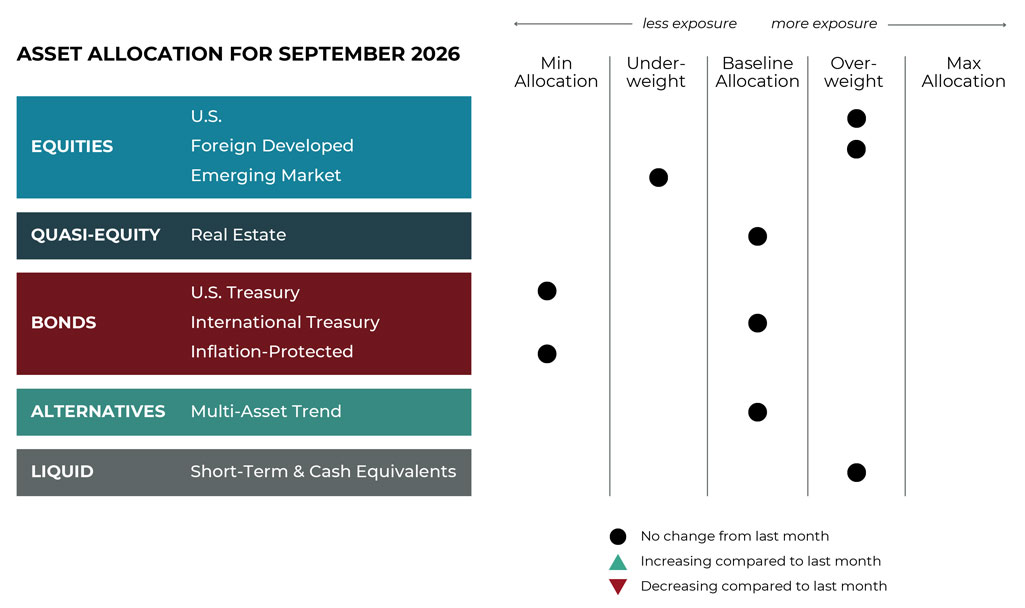
Source: Blueprint Investment Partners
Adjustments can vary across strategies depending on each strategy's objectives. What's illustrated above most closely reflects allocation adjustments for the Growth Strategy. Diversification does not guarantee investment returns and does not eliminate the risk of loss. Diversification among investment options and asset classes may help to reduce overall volatility.
U.S. Equities
Exposure will not change and remain overweight. Both the intermediate-term and long-term trends are positive.
International Equities
Overall exposure will not change and remain at baseline, with foreign developed markets continuing to be stronger than emerging markets and thus the former will be overweight while the latter is underweight. Trends across all timeframes for both sectors remain positive.
Real Estate
Exposure will remain at its baseline allocation as trends over both timeframes remain positive.
U.S. & International Treasuries
International Treasuries are now being partially expressed with an adaptive fixed income ETF. This will allow for continued baseline exposure and offer the ability to potentially benefit from both positive and negative trends. U.S. Treasuries of medium to long duration remain in downtrends across all timeframes and will continue to be underweight.
Inflation-Protected Bonds
Exposure will remain at its minimum with downtrends across both timeframes.
Alternatives
Short-Term Fixed Income
Exposure will not change and remain overweight, as this asset class continues to hold allocations from weaker fixed-income instruments.
Asset-Level Overview
Equities & Real Estate
After what seemed like a summer of discontent, the S&P 500 leapt to new all-time highs as August began and remained above previous summer highs for the month. Even with the positive performance and new highs, however, there has remained a pattern of mostly sideways direction. Nevertheless, trends over all timeframes remain positive and our portfolios will remain fully invested.
Overall, international equities were also positive in August. Breaking this down by developed versus developing economies, the former continued to outperform the latter. In fact, foreign developed equities is now the leading performer among the major asset classes our firm tracks, and we will remain overweight. Emerging markets have also regained their uptrends after the brief interruption, but their relative weakness versus the developed asset class will be enough justification to keep them underweight.
After outperforming domestic and foreign equities in June and July, real estate securities took a breather in August, finishing nearly flat. Trends continue to be positive leading our portfolios’ allocations to be at the baseline.
Fixed Income & Alternatives
Fixed income instruments continue to be poor performers, residing near their 2026 lows. Trends remain entrenched in a negative direction, resulting in our portfolios’ allocations being at or near their minimum levels. Until the pattern of uncertainty in the Middle East is broken and central banks are able to get inflation to their respective targets, positive trends are unlikely to develop.
Within the alternatives allocation, positioning remains largely unchanged at the asset-class level. Fixed income continues to be net short and is by far the largest net position overall. Equities and commodities remain net long, with commodity exposure led by metals and grains. Currencies have shifted further toward a net long position in international currencies (net short the U.S. Dollar).
3 Potential Catalysts For Trend Changes
Jackson Hole Fed Meeting: Federal Reserve Chairman Kevin Warsh indicated the central bank might keep raising interest rates to fight inflation. These were his most important comments since taking the role this spring, and investors saw them as a sign the Fed is more likely to increase rates. Warsh said he saw little evidence that borrowing and lending were slowing the economy. Better inflation numbers this summer hadn’t convinced him that the overall trend was improving. “We must be sure that underlying inflation is moving toward our goal clearly and fast enough. Otherwise, we have more work to do,” he said in an event during the annual meeting in Wyoming. Traders raised the chance of a rate increase next month to about 60% from 35%. Warsh described an economy showing few signs of slowing from the Fed’s current Fed funds rate of about 3.6%. “Credit and loan markets are showing few signs of policy restraint,” he said. Despite some signals of strain in housing and agriculture, he added, “On balance, I would be hard-pressed to describe broad financial conditions as restrictive.” Michael Arone, Chief Investment Strategist at State Street Investment Management summed up the situation this way: “Markets are interpreting Warsh’s speech as a one-way ticket towards higher rates.”
Consumer Sentiment: Consumer confidence declined in August, according to the University of Michigan’s monthly survey. The survey’s confidence index dropped to 51.7 in August, down from 55.2 in July. The August drop keeps confidence above the low levels around the mid-40s seen earlier this year. However, confidence fell by about 6% from last month and by about 11% from a year ago due to ongoing worries that inflation will remain high for the foreseeable future. “With ongoing policy uncertainty including the Iran conflict, consumers expect further increases in gasoline prices both soon and in the long term,” said Joanne Hsu, the survey’s Director. Confidence drops in August were seen across all political groups and were especially strong among Republicans.
Consumer Spending: The yearly inflation rate fell slightly in July, and a key measure of underlying price trends stayed moderate. So-called core prices, which exclude volatile food and energy costs, rose by 0.2% in July from the previous month, a small increase that gives hope that broader price pressures might be easing. Underlying inflation trends are especially important right now for the Federal Reserve, where leaders are deciding whether and when to raise interest rates. This report may make the Fed more willing to wait and see whether inflation continues to cool on its own rather than raise rates. Sales at U.S. stores fell in July, the latest in a series of weaker reports causing people to rethink an economy that had seemed to be speeding up this spring. Retail sales dropped by 0.6% in July, the Commerce Department reported, missing the 0.1% increase economists expected. These numbers came a week after the monthly jobs report showed the economy lost 23,000 jobs in July. Sales in the “control group” categories of everyday products that economists watch closely fell by 0.4%, the first such drop this year.
The Wall Street Journal, “Warsh Says the Fed May Not Be Done Fighting Inflation,” 8/28/2026; The Wall Street Journal, “Short-Term Treasury Yields Rise as Warsh Targets Inflation in Jackson Hole Speech,” 8/28/2026; The Wall Street Journal, “Consumer Sentiment Was Weaker in August, per Michigan Survey,” 8/28/2026; The Wall Street Journal, “Inflation Was 3.4% in July, Down Slightly From the Previous Month,” 8/12/2026; and The Wall Street Journal, “Weak Retail-Sales Number Adds to Softening Economic Data,” 8/14/2026
Hello Mag 7, Meet the Other 493
The rearview mirror is always clearer than the windshield.
—Warren Buffett
For much of the last several years, discussing the U.S. stock market has meant discussing seven companies. The “Magnificent 7” of Alphabet, Amazon, Apple, Meta, Microsoft, NVIDIA, and Tesla became the dominant force in the S&P 500. From the beginning of 2023 through early June 2026, the group gained roughly 150%, compared with approximately 50% for the equal-weighted S&P 500. Their extraordinary performance pushed the seven companies from less than 20% of the S&P 500’s market capitalization to roughly 35%.
In 2026, however, the script was flipped. As August ends, the broader market has been substantially stronger than the Magnificent 7. On a year-to-date, net-total-return basis:
- The S&P 500 excluding those seven companies is up approximately 15%
- The equal-weighted S&P 500 has gained roughly 16%
- The Magnificent 7 collectively are up less than 10%
That is a dramatic change in leadership. It is also a useful reminder of why we believe predicting markets is an unnecessarily difficult way to invest. Coming into 2026, an investor looking in the rear-view mirror could have reasonably concluded that the largest technology companies were precisely where they wanted to be. For several years, concentrating exposure in those stocks was rewarded handsomely. In fact, diversification away from them often felt like a penalty.
Then the market changed.
Today, strength is much broader. Financials, healthcare, industrials, and other areas that spent years in the shadow of mega-cap technology have participated more meaningfully. In late July, even as the Magnificent 7 had fallen more than 8% from their June levels, roughly two-thirds of S&P 500 constituents had risen and the equal-weighted index had gained nearly 4%.
Investors using a systematic trend-following strategy can find transitions like this to be challenging. Trend following is intentionally reactive rather than predictive. By definition, a trend must exist before a trend-following process can identify it. That means when long-established leaders suddenly retreat and new leadership begins emerging elsewhere, there can be a period when yesterday’s trends are weakening faster than tomorrow’s trends are strengthening.
We sometimes refer to this as the cost of confirmation. The alternative is attempting to predict the turning point. An investor would have needed to determine not only that the Magnificent 7’s remarkable run was about to cool, but also when it would happen, which stocks and sectors would replace them, and when those new trends would begin. Getting one of those decisions right is difficult. Getting all of them right consistently is something we do not believe investors should rely upon to achieve their financial goals.
That is an important distinction. Our objective is not to outperform every index during every market environment. It is not to perfectly identify every market top or be the first investor into every emerging trend. Our objective is to systematically participate in persistent market trends while managing risk when those trends deteriorate.
Despite the leadership transition and the challenges it can create for systematic investing strategies, returns have continued to move investors toward their long-term financial objectives. That is ultimately the scoreboard that matters.
Markets will always have leaders, but who they are will change. Yesterday it was the Magnificent 7. Tomorrow it will be something else. We do not need to know what that “something else” will be today. We simply need a process capable of recognizing it when it arrives.
Cmegroup.com, “Is the S&P 500's Concentrated Rally Starting to Diversify?,” 8/10/2025; Spglobal.com, “S&P 500 Ex-Magnificent 7 Index,” 1/1/2026 to 8/28/2026; and Reuters.com, “Magnificent 7 results set to test broadening US stock market,” 7/29/2026
Let's Talk
If you have any questions about what transpired in the markets last month or portfolio positioning for the month ahead